Boys Town distributes business reply envelope with new Christmas-themed artwork
September is absolutely flying past. I haven’t had a great deal of time to play around with my collection, but I have at least been keeping up with the flow of incoming mail, and this business reply envelope arrived in a mailing from Boys Town late last week.
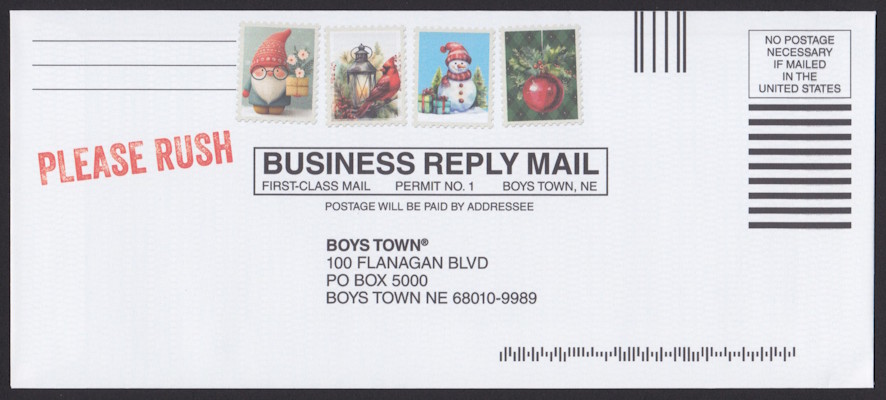
Boys Town business reply envelope with preprinted Christmas designs
As the image of the envelope shows, there are four preprinted stamp-sized designs with simulated printed perforations. They depict an elf with a gift; a cardinal with a lantern; a snowman with gifts; and a Christmas tree ornament.
Although nonprofits have for years sometimes affixed small amounts of United States postage to the business reply envelopes they distribute in an effort to boost response rates, Boys Town was a pioneer in using cinderella stamps affixed to their BREs before transitioning to designs preprinted directly on the envelopes.
As I’ve mentioned previously, given a choice, I would opt to receive envelopes with distinct cinderellas affixed, but even the preprinted stuff adds a bit of color to the contents of the mail I receive.
St. Joseph’s Indian School prints faux postage on BRE and outer cover
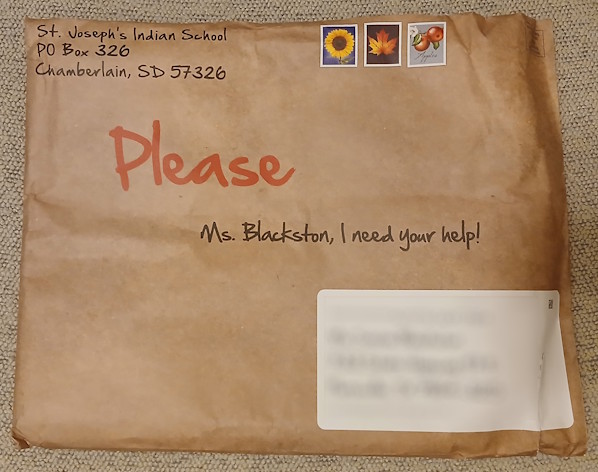
My wife received a rather unusual piece of nonprofit mail from St. Joseph’s Indian School in Chamberlain, South Dakota, earlier this week, and it caught my eye for a couple of reasons. First, at 14″×11″ in size, this envelope is really large for a nonprofit mailing.
Oversized St. Joseph’s Indian School cover
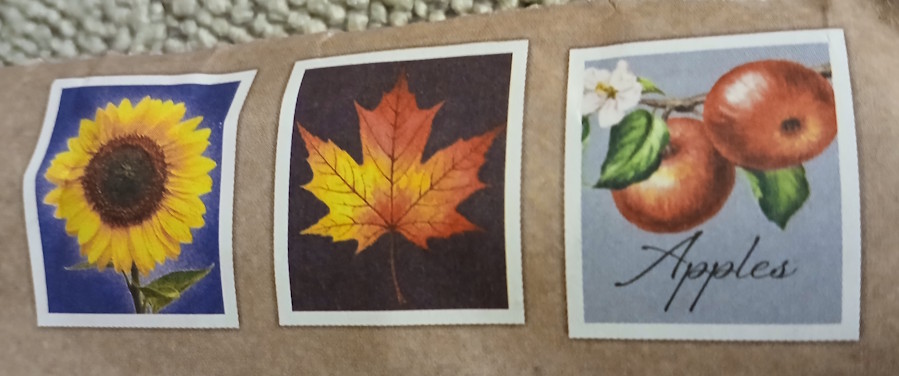
Second, there are three stamp-sized images picturing a sunflower, a leaf, and an illustration of apples where you would expect postage to be affixed.
Preprinted sunflower, leaf, and apple designs on St. Joseph’s Indian School cover
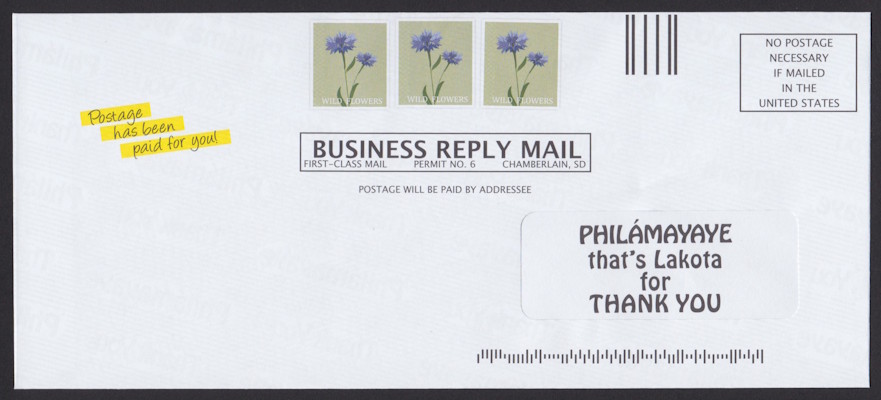
In addition to a variety of inexpensive tools and trinkets, the mailing also included a business reply envelope with three identical copies of a preprinted stamp-sized design captioned “Wild Flowers.”
St. Joseph’s Indian School business reply envelope with preprinted flower designs
I have to admit that the outer cover was a bit of a surprise. If you’ve been following along for any length of time, you know this isn’t the first envelope with imitation postage printed on it that my household has received, but such items seem to be much less common than their BRE cousins. It’s an interesting piece, and I doubt many like it will be saved.
This update contains spaces for all United States postage stamps issued from June through August, as well as this year’s federal hunting permit or duck stamp, and the new pages are ready for you to download and print at your convenience.
As always, thank you for your support and your interest in The Philosateleian!
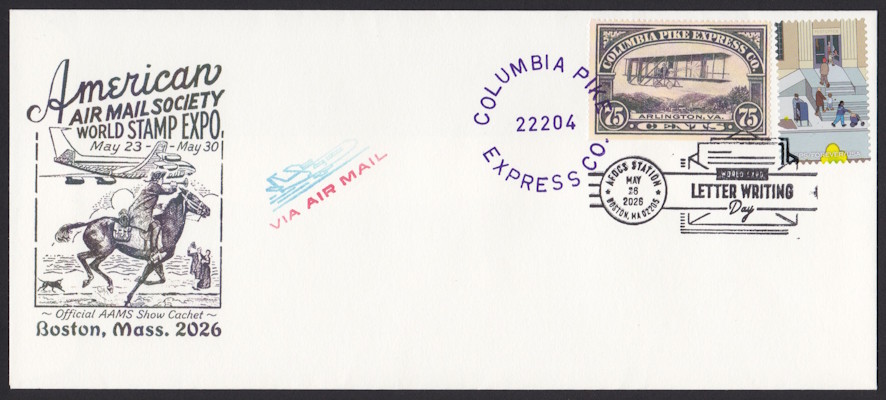
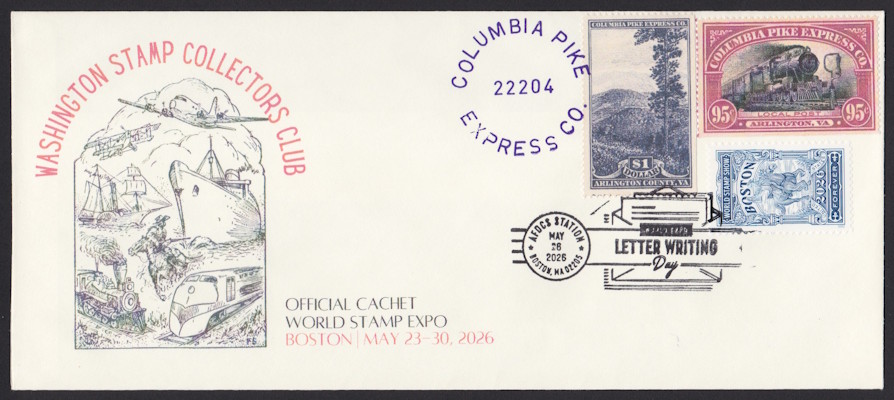
Last week, I received a mailing from Christopher that contained two covers bearing some of his local post stamps. One features an American Air Mail Society cachet, and the other a Washington Stamp Collectors Club cachet, both of which Christopher created for Boston 2026.
Columbia Pike Express Company 75¢ airplane stamp on coverColumbia Pike Express Company $1 Great Smoky Mountains stamp and 95¢ mail train stamp on cover
Although I do create my own local post stamps, I don’t consider myself much of an artist, but Christopher’s cachets are very, very nice indeed. And it’s always nice to receive “stamp mail”!
Bat’s Private Post celebrates 20th anniversary of operations
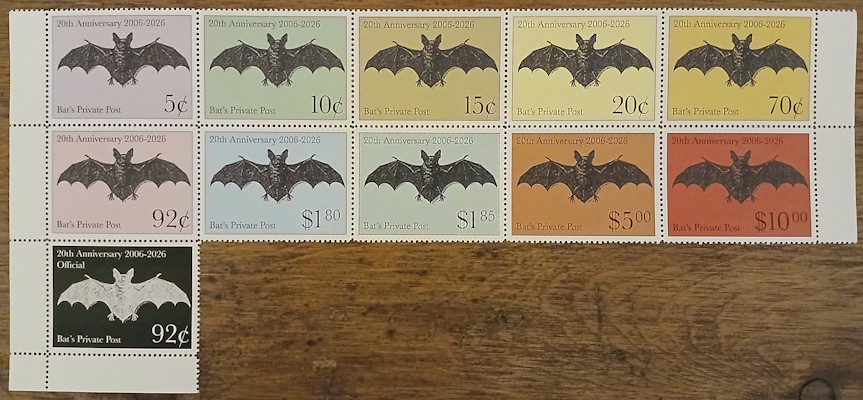
Beverly Hills-based Bat’s Private Post earlier this month celebrated its 20th anniversary with the release of a set of 11 commemorative stamps.
Each of the stamps issued August 18 features the local post’s namesake bat. The face values ranging from 5¢ to $10 are intended to meet various Bat’s Private Post fees.
Bat’s Private Post 20th Anniversary stamps
According to an accompanying announcement, the new stamps were printed and perforated by The Portland Stamp Company.
Bat’s Private Post is not the first private local post to reach 20 years—my own Philosateleian Post reached that mark in 2024, and New Hampshire’s Purgatory Post celebrated its 20th anniversary in 2021—but it’s quite a milestone. Congratulations to Bat’s!