Columbia Pike Express Company local post launches in Virginia
Over the past few months, I’ve been corresponding with a stamp collector in Virginia, Christopher P. Christopher has gotten interested in local posts, and he recently launched his very own: Columbia Pike Express Company.
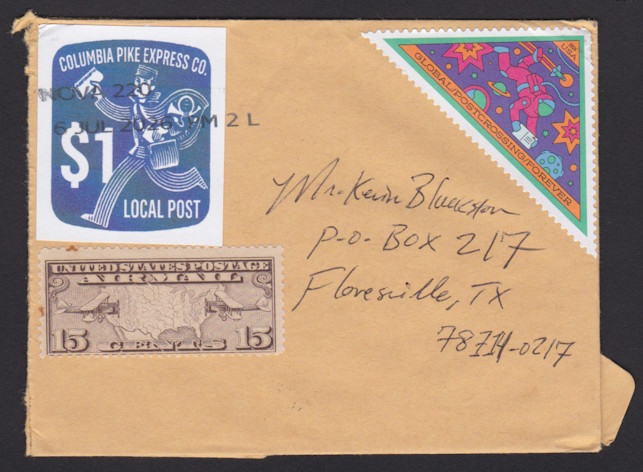
During one of my recent visits to my local post office, I found this mailing from Christopher in my PO box. The design of the $1 local post stamp on the cover was obviously inspired by an old Czechoslovakian newspaper stamp.
$1 Columbia Pike Express Company Mail Carrier stamp on cover
While I’m always excited to see someone new to local posting get his or her local post up and running, Christopher is already taking his operation to the next level. I simply carry mail from my house to my mailbox or to the post office, but Christopher has arranged for an Arlington-area pie shop to stock his stamps and collect mail from folks interested in joining the fun, and he then carries the collected mail (properly stamped with United States postage, of course) to a local post office branch for onward distribution. Pretty neat stuff!
Christopher has already come up with a bunch of stamp designs for Columbia Pike Express Company. You can see more on his local post’s webpage.
Philosateleian Post in July unveiled a new informational label to be used on certain pieces of mail.
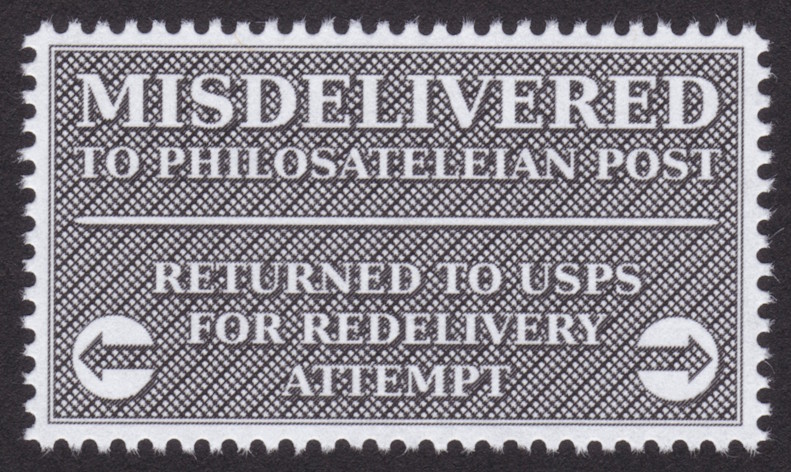
The label, which reads “Misdelivered to Philosateleian Post - Returned to USPS for Redelivery Attempt” will be applied to all mailpieces delivered to a Philosateleian Post address but intended for delivery to a different address.
Philosateleian Post Misdelivered label
“While receiving mail addressed to a different street address or a different post office box is far from an everyday occurrence for my family, we have received nearly a dozen such items since the beginning of this year,” states Philosateleian Post’s proprietor, Kevin Blackston.
“Having this label available to apply to mail that I have to return to the carrier or other USPS employee for proper delivery will give the intended recipient more insight into the cause of the delay in receiving his or her mail.”
Technical Specifications
Format: sheets of 36 (4×9). Plate number: P260705. Design size: 42×23 mm. Overall size: 45×26 mm. Separation method: perforated 12. Adhesive: water-activated dry gum. Printing method: laser.
Philatelic Services
To receive a mint single of Philosateleian Post’s Misdelivered label, send either $2 or a self-addressed stamped envelope and your request to:
Kevin Blackston
Philosateleian Post
PO Box 217
Floresville TX 78114-0217
United States of America
Taking a look at Philosateleian Post’s USA’s 250th Birthday stamp on FDC
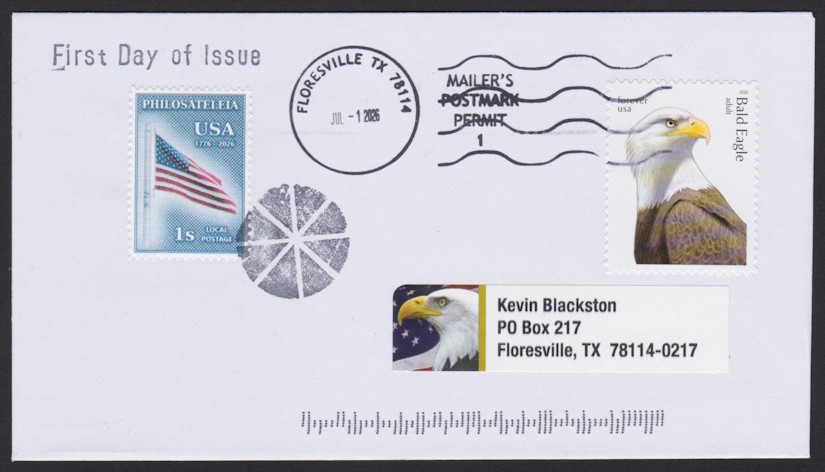
It has been nearly a week since I released Philosateleian Post’s stamp celebrating the USA’s 250th birthday, and nearly a week since my daughter pulled the first day cover I mailed myself from our post office box, and today I’m finally getting to share it with you!
Philosateleia 1s United States of America 250th Birthday first day cover
I thought the Bald Eagle stamps the USPS issued earlier this year would compliment my flag stamp quite nicely. As you can see, I postmarked the US postage using my mailer’s postmark.
It’s very common for my local post stamps to end up with some sort of damage after traveling through the mail, but the stamp on this FDC appears to have survived unscathed. What a nice surprise!
14¢ American Indian turns up on first flight cover mailed to South Dakota
It feels like it has been a long time since I added anything to my collection of 14¢ American Indian stamps on cover. I recently spotted a cover on eBay, however, that caught my attention.
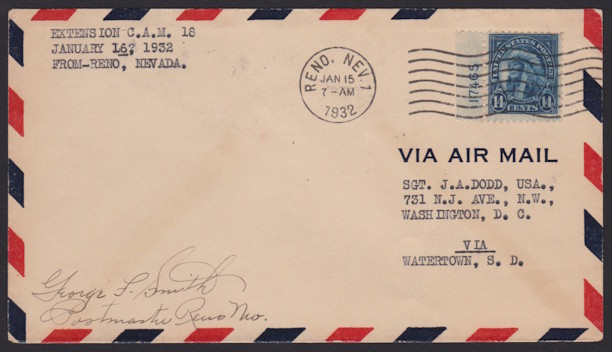
Mailed from Reno, Nevada, to Washington, D.C., this envelope was carried on the first CAM 18 route flight between Reno and Watertown, South Dakota.
14¢ American Indian cover carried on CAM 18 flight to Watertown, South Dakota
I haven’t been able to find anything definite about the addressee, but the postmaster who autographed the cover, George Smith, apparently had some political connections. He served at least informally as an advisor on post office matters to one of Nevada’s United States Senators.
While this is obviously a philatelic solo use of the American Indian stamp, the price was right. Including taxes and shipping, I paid $2.19 for this envelope. That’s easily the least I’ve ever paid to add a 14¢ cover of any sort to my collection!
Southern Poverty Law Center BRE features Statue of Liberty, DC landmarks
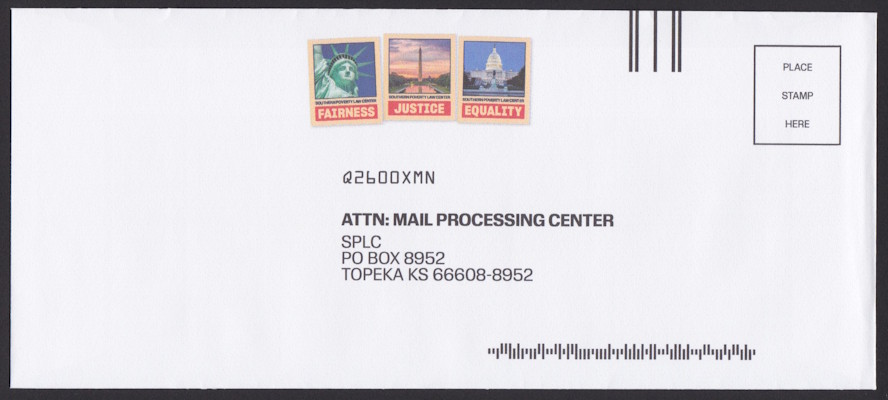
As the first half of 2026 draws to a close, I have one more business reply envelope to share with you. This one arrived this week in a mailing from the Southern Poverty Law Center.
The three preprinted stamp-sized designs on the envelope depict the Statue of Liberty with the word “FAIRNESS”; the Washington Monument with the word “JUSTICE”; and the United States Capitol with the word “EQUALITY.”
Southern Poverty Law Center business reply envelope with preprinted patriotic designs
Searching my archives, I don’t see that my family has ever received a BRE with faux postage on it from this particular organization. One more for the box…