14¢ American Indian COD cover not what it seems
There’s an old truism that things are not always what they seem to be. That statement applies just as much in stamp collecting as it does in life in general.
Take, for example, the newest addition to my 14¢ American Indian collection. This cover mailed from Charleston, West Virginia, in 1933 bears a parcel post postmark on its front, and my initial assumption when I saw it was that it was sent by parcel post or fourth-class mail.
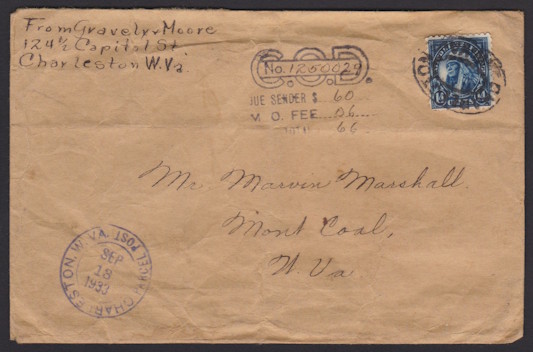
Upon closer inspection, however, I discovered that there’s no way this is an example of fourth-class mail. The collect-on-delivery fee applicable at the time this envelope was mailed was 12¢ for matter valued at no more than $5, and that leaves only 2¢ for postage. No parcel post rate was that low; even mailing a letter first-class cost 3¢ by the time this envelope was used.
I found the answer to this mystery in Henry Beecher’s and Anthony Wakrukiewicz’s seminal work U.S. Domestic Postal Rates, 1872–2011. In that volume, Wakrukiewicz illustrates two other covers that at first glance appear to be examples of fourth-class mail, but which actually had to have been sent third-class! That is the case with this cover, too.
A quick search turned up a couple of other interesting connections to this cover as well. You can read my full write-up for complete details.
Published 2025-07-28
Comments
Log in or leave an anonymous comment.