Collect on Delivery Cover
Although Collect on Delivery service was initiated nearly a decade before the 14¢ American Indian stamp was issued, examples of that stamp on mail sent COD are exceedingly unusual.1 In fact, the subject of this exposition is the only one of which the editor has personally seen.
Postmarked September 13, 1933, the cover illustrated here was mailed from the Gravely and Moore Photographers of Charleston, West Virginia, to Marvin Marshall of Montcoal, West Virginia.2 The handstamps on front and reverse indicate the recipient had to pay 66¢: 60¢ for what the envelope contained and 6¢ for a money order that was mailed back to the sender.
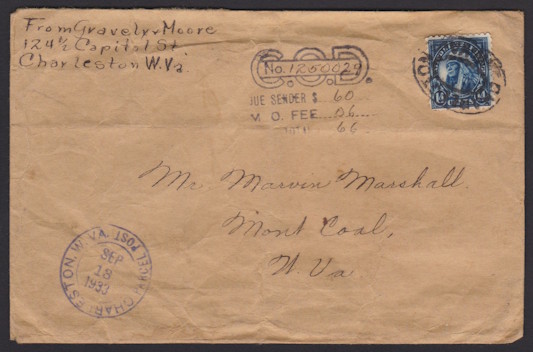
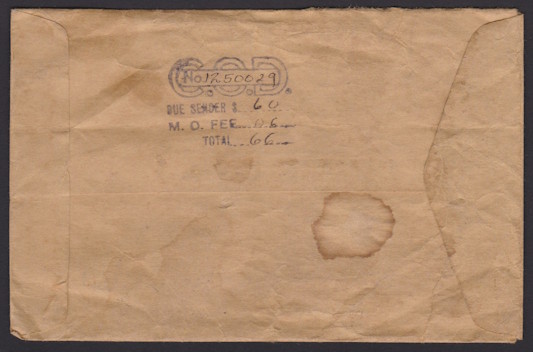
Because of the parcel post postmark, this envelope at first glance appears to have been sent via fourth-class mail, but that was not so. In 1933, the COD fee for a shipment valued at no more than $5 was 12¢; in this case, that leaves only 2¢ for postage—too little for either fourth-class or first-class mail at the time.
As Anthony Wawrukiewicz explains in U.S. Domestic Postal Rates, 1872–2011, postal regulations required that stamps on third-class mail be canceled with undated postmarks, which was done on this envelope; however, regulations also required that any piece sent COD had to have a dated postmark on it, and as no dedicated third-class postmarks existed, parcel post postmarks were used on such items. That appears to be the case here: the 14¢ stamp covered the 12¢ COD fee plus third-class postage.
It is possible the 14¢ stamp overpaid the COD fee and the 1½¢ per two ounces third-class rate in effect at the time the item was mailed by ½¢, but special third-class rates of 1¢ per ounce for books and catalogs and 1¢ per two ounces for material for planting also existed. In either of those cases, the 14¢ stamp would have exactly paid the applicable third-class rate.
Besides the highly unusual rate demonstrated here, there are two other interesting things about this cover. First, the Gravely of Gravely and Moore was Ben Gravely, who not only co-founded the photography studio with his wife’s cousin but also invented a motorized single-wheel plow.3 The company he founded would eventually develop the Gravely tractor, and the name lives on with a line of commercial lawnmowers still in production today.
The second connection is a much grimmer one. Montcoal, the community to which the envelope was mailed, would make headlines in 2010 when an explosion at the Upper Big Branch coal mine killed 29 people.4
References
- Beecher, Henry W., and Anthony S. Wawrukiewicz. U.S. Domestic Postal Rates, 1872–2011. 3rd ed. Bellefonte, Pennsylvania: American Philatelic Society, 2011.
- Gravely and Moore Studio, Photography Business in Charleston, Negatives. West Virginia University West Virginia & Regional History Center. Accessed 27 July 2025.
- Gravely History: Strong Roots Run Deep. Gravely. Accessed 27 July 2025.
- Phillips, Jessica. Remembering the Upper Big Branch Mine Disaster 14 Years Later. 59 News. 5 Apr. 2024. Accessed 27 July 2025.
Published 2025-07-27 Last updated 2025-07-28