Night Air Mail Cover
When official air mail service was introduced in the United States in 1918, it cost 24¢ to mail a letter weighing no more than one ounce.1 That was later reduced to 16¢, and then to 6¢, so what was the 14¢ American Indian stamp doing by itself on an air mail cover mailed in 1923?
The answer, of course, is that this is a very early philatelic use of the stamp on something other than a first day cover. Formal air mail service was discontinued beginning July 18, 1919, and was not reintroduced until July 1924. In the intervening five years, mail could travel by air at the regular first-class rate of 2¢ per ounce if sufficient room was available on the planes being used to scope out the transcontinental air mail route, and that’s what this envelope did. The 14¢ postage paid seven times the required rate.
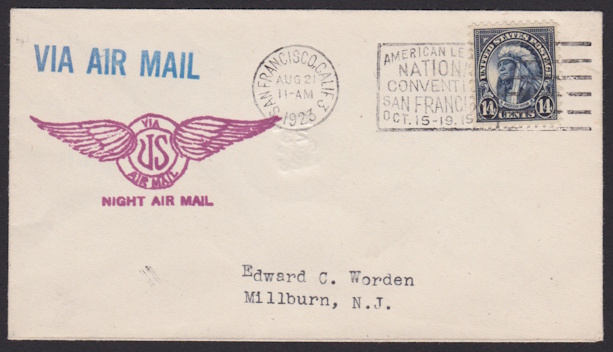
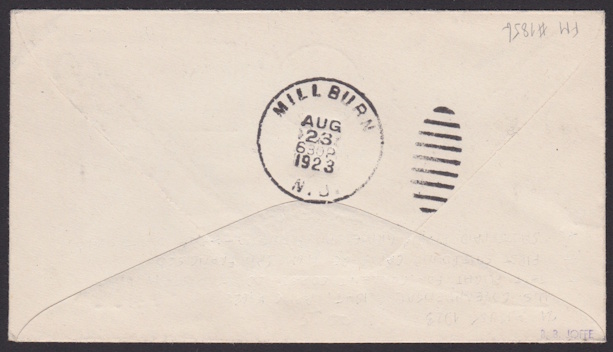
Bearing an August 21, 1923, machine cancellation from San Francisco, California, and a “Night Air Mail” handstamp, the cover was serviced by and addressed to Edward C. Worden, an early first day cover enthusiast whose typewritten name is seen on many FDCs of this vintage.2
The envelope made its cross-country trip uneventfully, as evidenced by the August 23 duplex cancellation from Millburn, New Jersey, on the reverse.
References
- Beecher, Henry W., and Anthony S. Wawrukiewicz. U.S. Domestic Postal Rates, 1872–2011. 3rd ed. Bellefonte, Pennsylvania: American Philatelic Society, 2011.
- Dr. Edward Chauncey Worden. Find a Grave. Accessed 31 Jan. 2025.
Published 2025-02-01